Showing posts with label Indonesian literature. Show all posts

Monday, 11 March 2013

Turning Pramoedya's This Earth of Mankind into a movie | RadioNational — ABC (audio)


“Film maker Riri Riza has taken on the challenge of getting the work of one of Indonesia's most controversial writers made into film. Pramoedya Ananta Toer was jailed for 14 years without charge during the Suharto regime and spent 11 of those years on Indonesia's infamous Buru Island prison. While he was there he wrote four historical novels called the Buru Quartet, which were later smuggled out and became bestsellers. Riri Riza plans to make the first book in the Buru quartet, This Earth of Mankind, into a film which tells an epic love story of nation building.”

Unlocking Indonesia Through An Exploration of Its Literature | C.W. Watson

Visitors attending the Indonesia Book Fair 2011 in Senayan, South Jakarta. With
so much Indonesian literature being translated, it has become increasingly easy for
expatriates to learn more about their adopted country. (JG Photo/Yudhi Sukma Wijaya)
“Reading novels is an excellent way of getting to know something about a country when one is newly arrived, doesn’t know much about it, and is going to be spending some time there. Certainly this was my experience coming to Indonesia for the first time some decades ago.

Only at that time I was hampered by the fact that there were few novels — only ones by Mochtar Lubis as far as I’m aware — that had been translated into English or any other foreign language which I could read.

I had to learn Indonesian first before I could start reading the literature and it took me a year of hard work before I could comfortably read fiction.

But the hard work paid off, and I plunged into all the novels and short stories that I could lay my hands on (not always easy to obtain at that time) and found myself entering a new world, one which bore an ambivalent relationship to the one that I had learned about over a year of personal experience, bemused observation and animated conversation with friends and mentors about recent history and the place of religion and culture in Indonesian society.

One of the reasons for the ambivalence was that in fact there had been very few novels published between 1962 and 1972, so there was nothing describing contemporary events. What I was reading then, constituted the reflections, mediated through the fiction of writers from the period before 1962, a historical period of about 50 years, since it was only around 1910 that novels and fiction began to circulate widely in densely populated areas in the archipelago.

Storytelling, Indonesian Literature and a Lost Soul | Tika Y. Sukarna

“In Indonesia, literary works as they were introduced in our school system is a list that we were never given the time to read but only to know how to answer correctly on multiple choice and fill in the dots exams. Nobody reads them, not even the Bahasa Indonesia teacher whose job was to dictate to us the names of who was forced to marry whom, what eventual disease caused their ultimate doom, in what year it was written, by which class of author and in what era.

A nation originating from a people known for the depth and richness of our art and cultural heritage, I find this systematic pruning of our stories paradoxical. It is as if we had been maliciously robbed, our souls exorcised, we have become just remnants, empty shells of the great people we once were. A people who once braved and navigated the oceans even before Marco Polo or Columbus, who had the tenacity and insight to gather layer upon layer of perfectly chiseled stone slabs that made our Candi Borobudur, who carefully weaved the golden and silvery threads in our Kain Tapis, spun the melody of water and birds into our Kecapi Suling, and infused the souls of the unseen into the majestic chime of our bronze Gamelans.”

Sunday, 3 March 2013

Diplomacy through poetry | Khairani Barokka

Gulf Between Australia and Indonesia a Lot Narrower When We Take a Stanza

“Late last year at a Canberra cafe I led an improvised poetry workshop. In the spirit of creative writing, I asked five Indonesians to each shout out a word they associated with Australia. Out came “barren,” “desert,” “barbecue,” “kangaroo” and “Corby.” In contrast, the five words Australians chose to depict Indonesia were: “spicy,” “steamy,” “islands,” “intricate” and “batik.”

Keep in mind this was not your everyday Australian setting. It was a gathering organized by Australian National University’s School of Music Poets and Australian Poetry, titled “Meet Your Neighbors,” where academics and writers discussed all things poetic beneath sarongs that hung across the Biginelli Espresso Cafe.

Doesn’t it make you wonder what words others would use to describe the country across the water, if you asked a random assortment of warung-goers in Semarang or pub-goers in Sydney?”

Saturday, 23 February 2013

Andrea Hirata's The Rainbow Troops

“WHEN it comes to learning about Indonesia from fiction, most Australian readers won't have gone much further than Christopher Koch's 1978 novel, The Year of Living Dangerously. It is a wonderful and important book, but part of its point is that it presents an outsider's view. The Rainbow Troops, written in Indonesian and first published in 2005, is very much the view from inside: it's an autobiographical novel in which Andrea Hirata recalls his childhood on the island of Belitong, where he attended the village school.

The Rainbow Troops has become a cult novel in its own country and is the first Indonesian novel to find its way into the international general fiction market. Hirata has written three sequels, and in 2008 the first novel was made into an award-winning film.

The troops in question are the 10 children - ''Belitong-Malays from the poorest community on the island'' - who attend Muhammadiyah Elementary School: ''It, too, was the poorest, the poorest village school in Belitong.'' They are taught by the dedicated but ageing Pak Harfan and his offsider, Bu Mus, a 15-year-old girl on her first day of teaching. From this day, which is when the story starts, the school is in constant danger of being closed down, and is always being compared unfavourably with the prosperous school run by the company that owns the island's tin mines.”


Thursday, 3 January 2013

Documentary Special: Hidden History — Pramoedya Ananta Toer

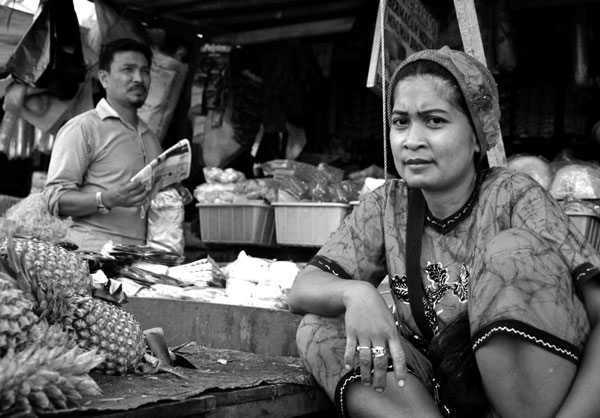
Portrait from Blogger
Majelis Sastra Madiun
“The late Indonesian writer Pramoedya Ananta Toer was a noted historian, journalist and novelist, famous internationally but banned at home.

He was gaoled by both colonial and Indonesian governments and even by the man he'd supported, Indonesia's first president Sukarno.

Pramoedya not only documented Indonesia's growth into an independent nation, he wrote compassionately of a history long suppressed.

Today, there are growing calls for one of Asia's most turbulent periods to be open to more scrutiny and Pramoedya's books accepted as an important contribution.

Karon Snowdon travelled to Indonesia to learn about the country's hidden history.”

“Introduction / Pengantar: Crossing Bloodlines” by Deborah Cole, Cordite Poetry Review: Indonesia Special Issue

“The poems in this collection trace the overlapping cycles of the human journey from birth to death across the space/time habitat we measure in footfalls and poetic metre. Travelled in the company of family and community, our journeys enact the species’ heritage and legacy of kinship and violence – two sides of the same struggle towards a longed-for intimacy that might negate the spatial, temporal and psychological divide between the other and the self. Through commingling languages and intertwining elocutions, this issue explores the distances and intimacies between a varied set of human journeys by poets writing in Indonesia and Australia. As these two countries are so close on maps – but oftentimes, sadly, only on our maps – these poems invite the re-arrangement of our conceptual geographies.


This collection began as a conversation between Kent MacCarter and Sapardi Djoko Damono (arguably Indonesia’s best-known contemporary poet and leading literary scholar). The goal was to create a translation exchange that would showcase established poets whose work was still very much on the rise with a balanced representation of gender, ethnicity and region in each country. A second conversation between MacCarter and John McGlynn (leading translator of Indonesian literature into English and editor-in-chief of The Lontar Foundation) led to an invitation to McGlynn, poet Dorothea Rosa Herliany and me (Deborah Cole) to join the project – an invitation that we accepted enthusiastically.”


An extract from another essay in this volume was featured earlier on this site: “Notes about the INDONESIA Special Issue | Kent MacCarter ”

Sunday, 30 December 2012

Notes about the INDONESIA Special Issue | Kent MacCarter

“When I approached major Indonesian poet Sapardi Djoko Damono – godfather of that sprawling nation’s contemporary poetics and a renowned translator of English-language works into Bahasa Indonesia – about working with me on a kind of ‘translation exchange’ to then publish online and promote in our countries, he e-replied enthusiastically that ‘we must’!

But it was with a slight twinge – the kind of cogent relish fork that skewers your mood (just enough, but none too deep) when you learn your most recent great idea is not as original as its first eureka promised you – that I read further into Damono’s email to learn that he’d done exactly this back in 1991 (sans the online angle). Mendorong Jack Kuntikunti: Sepilihan Sajak Dari Australia collects one to two poems from 41 Australian poets; together, the works form an anthology with Indonesian translations published side-by-side with the English originals. Co-editor for the project was Canberra-based poet R F Brissenden. Damono sent me a well-loved copy of the book immediately (I imagine it’s well out of print).”