Showing posts with label Philippine literature. Show all posts

Monday, 18 March 2013

The unfinished Maria | Gilda Cordero-Fernando

MARIA was patterned after Tingting’s daughter Liaa Cojuangco,
when she was a teenager. The artist had a crush on her and
clipped her photos from newspapers. Art by Antonio Mahilum
“Mariang Alimango is one of several Cinderella-type stories in Philippine literature. In the 1990s I wanted to make it into an illustrated children’s book in two languages, the Filipino part by Virgilio S. Almario, who has since become National Artist, and the English part by me.

I engaged a relatively unknown representational painter named Antonio Mahilum to do the illustrations, since I had seen his fantastic craftsmanship in a brochure. What he lacked in imagination, I thought cockily, I’d supply. The paintings were to be in oil, about 2 ½ x 2 ½ ft size canvases.

It had never been specified that Maria’s family was poor. Since GCF Books then was working on a “Philippine Ancestral Houses” book, I thought I’d give Maria a beautiful dwelling like the one we had photographed in Bustos, Bulacan.

Then I got more ambitious. I thought the book should also serve as a children’s primer on old houses. It would be useful also as a model for adult artists, who drew such awful bahay-na-bato as I often saw in weekend magazines.

Every object in Maria’s house was to be authentic to the period. Since Maria was treated like a servant, she had to be in the kitchen most of the time, so that, too, would be meticulously equipped.”


Sunday, 17 March 2013

Filipina Maid of Cotton writes A Ballad of Stone and Wind” | Edu Jarque


“Anna Maria “Bambi” Lammoglia Harper was born to write Agueda: A Ballad of Stone and Wind, the historical novel that traces the turbulent transitional era of Philippine history, from 1898 to 1935, as seen through a young girl’s life and the events that shaped both her and her country.

The 251-page narrative believably re-imagines the past of the decadent colonial Manila of our grandparents and great-grandparents, of its people grappling with changes brought about by a new master.

Agueda, despite the cruel hardships of her life, possesses enough intelligence and adaptability, like all conquered people, not just to survive but to triumph. It is easy to become attached to the whimsical child of the opening chapters and to feel sympathy and even empathy with her as an adult caught in the world where Filipinos were second-class citizens and women mere chattels.

It opens with a Manila that had Intramuros at its center and Binondo its commercial hub. While it romanticizes the city with a pristine Pasig River and seeks to continue to mythologize Intramuros, the story, nevertheless, depicts the hypocrisy, decadence and corruption of a dying era.

Bambi, as the author is also known, is a student of history and tradition, heritage and custom, arts and culture and more important, a Filipino who has intense passion for all these. Manila lives in her veins.”

Monday, 4 March 2013

Best of Philippine Speculative Fiction


“The University of the Philippines Press has launched The Best of Philippine Speculative Fiction 2005–2010, a selection of some of the best short stories from the first five years of the nationally- and internationally-acclaimed annual anthology series, Philippine Speculative Fiction.

PhilSpecFic, as it is affectionately referred to, is the centerpiece of one of the most important movements in contemporary Filipino literature, nurturing and encouraging Philippine authors to ply their craft in the realms of fantasy, horror, science fiction, magic realism, folklore, alternate history, and other related “nonrealist” genres and subgenres.”

Literary networking PENMAN By Butch Dalisay (The Philippine Star)


Novelist Tony Enriquez, playwright Steven Fernandez, and fictionist
Tim Montes enjoy a laugh at the inaugural Taboan in 2009.
“At the recent Taboan Philippine Writers Festival held in Dumaguete last month, I sat on a panel devoted to the topic of “Literary Networking,” which deals with how writers come into contact with one another and with other people in the profession publishers, editors, agents, and, of course, readers, teachers, and critics to improve and to promote their writing.

In my column two weeks ago, I noted how writing can be one of the loneliest if not most thankless endeavors anyone can undertake, especially in a country where writing is considered to be little more than a hobby. Networking helps reduce that sense of isolation and creates communities of writers and other literary professionals who are all looking for that same one thing: the next great read. So today I’m going to list down some of the most effective ways of literary networking, hoping that our writers, especially the young ones, can avail themselves of these venues to extend their reach.”

Sunday, 3 March 2013

NCCA's Taboan 2013: Writing politics, rites and icons in Dumaguete

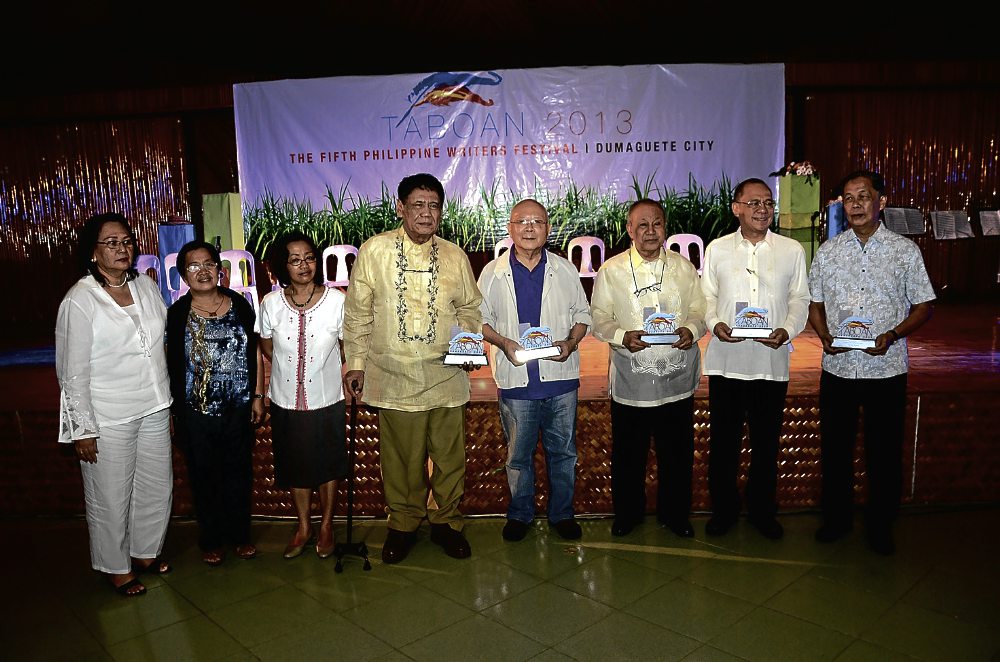
TABOAN Lifetime Achievement awardees

“In the tales of Scheherazade, a company of merchants and travelers set sail in the seven seas, voyaging from isle to isle, trading goods in the marketplace of cities. They would be received in magnificent halls and seated with nobles and sheikhs to conduct more trading—exchanging stories of marvels and adventures.

The Taboan Writers Festival was established to serve as a marketplace for creative and critical interface between writers, readers and the local communities. Since 2009, the festival has journeyed from region to region, supplemented with satellite activities across the archipelago.

A flagship project of the National Commission for Culture and the Arts’ (NCCA) Philippine Arts Festival (PAF), Taboan 2013 was held on Feb. 7-9 in Dumaguete City, Negros Oriental.”

Tuesday, 19 February 2013

Poet E. San Juan publishes 4th book of poems in Filipino

“US-based Filipino scholar E. San Juan, Jr., emeritus professor of English, Comparative Literature and Ethnic Studies, has just published his fourth book of poems in Filipino, "Bukas Luwalhating Kay Ganda," sponsored by the Philippines Cultural Studies Center.

His previous collections include "Alay sa Paglikha ng Bukang-liwayway" (Ateneo U Press), "Sapagkat Iniibig Kita" (U.P. Press), "Sutrang Kayumanggi" and "Mahal Magpakailanman" (LuLu.com).

San Juan is currently a fellow of the Harry Ransom Center, University of Austin, Texas. He was a fellow of the W.E.B. Institute, Harvard University, for which he is completing a monograph on “African American Internationalism and Solidarity with the Philippine Revolution.” A part of the research has been published in Socialism and Democracy, July 2010, and in the e-journal Cultural Logic.”

Thursday, 14 February 2013

Playwright Bonifacio Ilagan and other Philippine dictatorship victims to be compensated


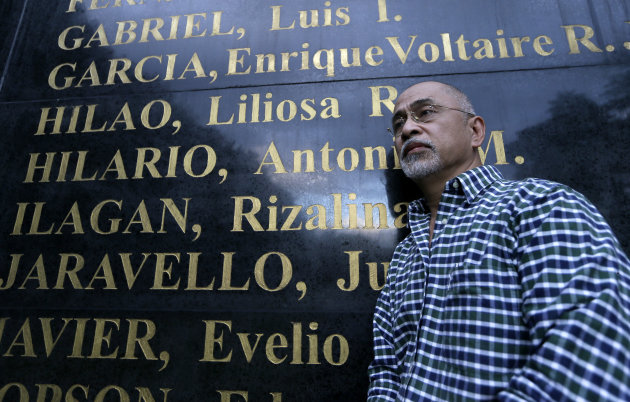
“Almost four decades after he was arrested and tortured and his sister disappeared into a maze of Philippine police cells and military houses, playwright Bonifacio Ilagan is finally seeing his suffering officially recognized.

A writer for an underground communist newspaper, Ilagan and thousands like him were rounded up by dictator Ferdinand Marcos' security forces after he placed the Philippines under martial law in 1972. Detentions, beatings, harassment and killings of the regime's opponents continued until Marcos was toppled in 1986.

Even though democracy was restored, it would take another 27 years for the Philippine Congress to vote on a bill awarding compensation and recognition to martial law victims. The bill was ratified Monday and will be sent to Pres. Benigno Aquino III for signing into law, said Sen. Francis Escudero, a key proponent.

"More than the monetary compensation, the bill represents the only formal, written document that martial law violated the human rights of Filipinos and that there were courageous people who fought the dictatorship," said a statement from SELDA, an organization of former political prisoners that campaigned for the passage of the bill.

Ilagan's story is more of a rule than exception among leftist activists of his generation.”

Sunday, 27 January 2013

Contemporary Filipino theater–between book covers


“One fine day, Nanding Josef, the articulate artistic director of Tanghalang Pilipino (TP), resident drama group of the Cultural Center of the Philippines, called up to announce that TP’s 25th anniversary was fast approaching. And would I like to write a book about the organization and its accomplishments?

Hmm. Definitely I was interested. I hadn’t written a book for several years, and was tired of living in genteel penury like some aging character in a Henry James novel.
So initial meetings were set up, an outline was drafted, a budget was prepared, and the go-ahead signal eventually came from the TP chair, Tonyboy Cojuangco, and its board of trustees.
Immersion

For about a year I would go almost daily to the TP offices located behind the CCP and immerse myself in their archives, which were more or less in good order. I pored over the bound volumes, souvenir programs, historical background, notes from the directors and production designers, press releases, preproduction information, photos and illustrations of set designs, and musical scores.”

Tuesday, 8 January 2013

F Sionil Jose reviews Chronicle of a Life Foretold by Mila D. Aguilar


From the same column as Jose's comment on the readership of Philippine literature (below), comes his review of Mila D Aguilar's Chronicle of a Life Foretold.

Mila D. Aguilar (nom de guerre Clarita Roja) was a University of the Philippines teacher. She continues to be a teacher and more. She was very much involved with the revolutionary opposition to Marcos and the oligarchy for which she paid dearly, with years in prison. She continues to resist and her resistance now is strengthened by her religious faith and her continuing devotion to her art, as this brilliant collection of poetry — her latest — illustrates.

I have admired Mila since the ’70s when I became aware of her work, and this admiration continues to this very day when so many of her contemporaries have fallen by the wayside or succumbed to the pleasures of a bourgeois life.

I also remember fondly her publisher — the still struggling, fighting, persevering bookstore Popular, whose founder Joaquin Po I met in the ’40s and whose friendship I have always valued.”

F Sionil Jose: “No Filipino writers in their reading lists” | Hindsight

Filipino author F. Sionil Jose (front row, sec...
Filipino author F. Sionil Jose is one of the Philippines' most popular writers. He wrote a series of books based on the time of the American occupation of the Philippines, as well as the provocative novel Ermita , named after Manila's notorious red-light district. (Photo credit: Wikipedia)
“Thank God, De La Salle professor Elfren Cruz and his wife Neni, who heads the Book Development Council, had several Filipino books on their Christmas gift list. Otherwise, if those celebrities and personalities are to be believed, we have no authors worth reading. Their lists of the books they like best do not include our writers, not Rizal, not Nick Joaquin, not Ben Santos. I’d like to mention more who are still alive, but naming the dead raises no controversies.

For decades, as literary editor, I have followed the growth of our creative writing in English. In my Solidaridad Bookshop, half of my stock consists of Filipino books written in English and in the native languages. I just went through our 2013 catalogue. In it are discoveries of great academic and creative writing.

Why don’t our celebrities read Filipino authors? Is it colonial mentality that has afflicted them? Or intellectual snobbery which concludes that Filipino writers are incapable of intellectual and artistic excellence? I’ll be charitable and say it’s ignorance, aggravated by an educational system that diminishes reading, of bookshops which tuck Filipino titles in inaccessible corners called Filipiniana.”

Saturday, 5 January 2013

Dr. Ruth Elynia S. Mabanglo, Multi-awarded Poet and Presidential Awardee | Asian Journal

“CONSIDERED as one of the leading female Filipino poets of our time, Dr. Ruth Elynia S. Mabanglo’s success did not come easy.

If you read her biography, it seems as though awards and recognition sprinkle her like tiny drops of rain.

For the past 30 years, Mabanglo has racked up awards from being the first woman to receive the Don Carlos Palanca Memorial Awards for Literature Hall of Fame, “Makata ng Taon” Poet of the Year by the Commission on Filipino Language, to earning the Manila Critics Circle National Book Award for Poetry for her book, Mga Liham ni Pinay (The Letters of Pinay).

Most recently, President Benigno Aquino III awarded University of Hawaii professor Mabanglo the 2012 Presidential Awardee for Filipino Individuals and Organizations Overseas, in the “Pamana ng Pilipino” category.

The Presidential award is given to Filipino individuals and overseas groups, in recognition of their outstanding contributions to national development efforts, or their outstanding achievements in their field of profession.

In the Pamana ng Pilipino category, Mabanglo exemplified the talent and industry of the Filipino, and brought the country honor and recognition through excellence and distinction in the pursuit of their work or profession.”

For Mabanglo, a professor and coordinator of Filipino and Philippine Literature Program at the University of Hawaii, it’s been a difficult but worthwhile journey.

Sunday, 30 December 2012

New novelist in town

It’s always a pleasure to welcome a new novelist into our ranks, and today will be one of those happy days when we acknowledge the arrival literally and figuratively of a new talent in our midst, Dr. Almira Astudillo Gilles, or just Almi to her friends. Almi flew in from Chicago as one of 29 recipients of the 2012 Presidential Awards for Filipino Individuals and Organizations Overseas, which were given out last Dec. 5 by President Aquino at Malacañang. I had met her at the ICOPHIL conference in Michigan last September, although she had introduced herself to me by email earlier, as a fellow Filipino eager to make contact -with other writers in the US and the Philippines.

Last Dec. 9, Almi also launched her first novel, The Fires Beneath: Tales of Gold (San Francisco: Philippine American Writers and Artists Inc., 2012), at the Ayala Museum. The novel deals with how a poor man’s discovery of ancient gold in the Philippine South changes him, his family, and his community. I haven’t finished reading the book, but I’ve been much impressed by her sharpness of eye and precision of language.

Friday, 28 December 2012

Center to launch book of late Kapampangan poet

The Center for Kapampangan Studies at Holy Angel University

“Center for Kapampangan Studies (CKS) of Holy Angel University will launch today late poet Delfin Turla Quiboloy’s book entitled “Iyas King Balas” (Gem on the sand) in his hometown in Lubao.

“The book is a collection of poems made by Quiboloy during his lifetime” CKS Director Robby Tantingco said.

“The launch, to be held at the Diosdado Macapagal Museum, shall feature music and poetry reading. Quiboloy’s son Dante will speak in behalf of the family while Romeo Rodriguez shall give a message in behalf of all Kapampangan poets in his capacity as Prinsipe ning Parnaso” Tantingco added.”

Monday, 24 December 2012

The case of the disappearing audience | Exie Abola (The Philippine Star)

Nonie Buencamino with Agnes Sarreal, Tara Cabaero, Rayna Reyes and Hazel Maranan in
Tanghalang Pilipino’s Stageshow at the CCP
Whenever someone tells me that the market for local theater is limited, and then uses this apparent truth to throw up his hands as if to say, well, we’ve done all we can, we can’t do any more, I think of my students. Almost every year I teach the first year introductory literature courses in Ateneo de Manila, and each year I send them to watch a few plays, whatever I like from the offerings of the various Manila-based theater companies.

Ah, my students. A handful are stereotypically coñotic. Many are ignorant of Pinoy pop culture, sometimes alarmingly so. (I still remember the time I asked, “What if Piolo Pascual were to walk through that door this very minute?” A boy sitting in front asked, “Who’s Piolo Pascual?”) They tote the latest gizmos and gadgets as if they were cheap junk jewelry. They spend free hours studying in the coffee shops across the highway, guzzling frappuccinos while poring over their books. When I ask at the start of the school year how many have seen a play recently that they weren’t required to watch, only one or two hands go up in a class of 30. Inevitably it’s a Broadway musical done here or abroad.

So I usually send them to plays that are distinctly Filipino, exploring some aspect of our people’s experience. Many times these plays are in Filipino, a language my students often don’t love. And of course, there’s the reluctance. They’re not excited to learn that they’ll have to trek to an unfamiliar part of the metropolis on a weekend. (Terra incognita includes the Cultural Center of the Philippines, the PETA Theater Center, and even UP–Diliman’s Palma Hall.)”