Showing posts with label Filipino American Literature. Show all posts

Monday, 25 February 2013

Kris Aquino as Massacre Queen and other 1990s Philippine inside jokes in Linmark’s new novel, Leche


“The winner of the Mr. Pogi Hawaii 1991 finds the opportunity to visit the Filipino communities in the United States mainland.

But Vincent “Vince” de los Reyes, the first runner-up and an honors graduate of University of Hawaii in Manoa, gets to visit the Philippines for a week, including a live interview with Kris Aquino.

De los Reyes’ return to his homeland after 13 years takes place in 1991, when the country is beset with power blackouts, the specter of the return of Marcos, and the eruption of Mt. Pinatubo after 600 years.

“Leche” is Vince’s account of his stay in the Philippines at that time, complete with tourist tips, snippets from a book (“Decolonization for Beginners: A Filipino Glossary,” written by his UH teacher Bonifacio Dumpit), his bangungot journal and vintage postcards bought from National Bookworm.

The novel “Leche” (355 pages, published by Coffee House Press) is by Filipino-American R. Zamora Linmark, who holds a dual citizenship. It is a fitting follow-up to “Rolling the R’s,” his 1997 novel about the young Vince, his siblings and classmates as they adapt to Hawaii after living in a town in the North. Now Vince has gone out of the closet and supposedly wizened up to the world. But not Manila, as Vince’s misadventures will show us in the novel.”

Saturday, 23 February 2013

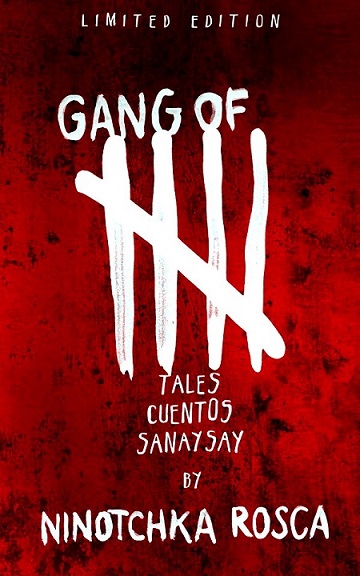
High five for Ninotchka Rosca's new novel Gang of Five | Joel David


“Assertive, impatient with detractors, firm in her convictions, unsparingly self-critical, she would nevertheless surprise everyone with a graciousness that could only come from a first-hand familiarity with people-oriented service – from gestures as casual as sharing pictures (of her home, or her past) that made her happy, to helping an infirm neighbor abandoned by everyone else, to offering assistance to anyone devastated by natural calamity.

My “Gang of 5” copy will never leave my personal book shelf, mainly because of the author’s signature affixed to a handwritten quotation from Conrad Aiken – and also because of the text, “Limited Edition,” affixed above the title.

In an exchange, Rosca said that the book will be available to a general readership by mid-year, and however one cuts the argument, it would be a major loss for readers of Philippine literature if it weren’t.

For this, out of all the several anthologies of English-language Pinoy short fiction ever put out, will satisfactorily serve as the all-purpose single-volume introduction to local writing that anyone will ever need.

None of the five pieces is less than inspired, each one represents a writing challenge distinct from the rest, and everything builds up to the larger anticipation of greater pleasures awaiting in the output of other Filipino authors – final proof of Rosca’s generosity of spirit in honoring her colleagues by providing evidence of how equal they are, as she is, to the challenge of literary excellence.”

Sunday, 23 December 2012

Barbara Jane Reyes on Creating or Destroying Readers in Filipino-American Literature 2


“I was talking to one of my grad students last night about the place of art in our political and cultural movements. What is art supposed to be “doing” there? Is the expectation of pragmatism what cripples the art by making it have to be didactic and dogmatic? Or is there something deeper we need to look at? I think about claiming to be disconnected from great literary traditions as a community, such that we get to a point that we feel we have no great literary traditions, which leads to the sentiment that great literary traditions have nothing to do with us. This is fallacious logic.

I keep thinking of an introduction to a volume of poetry by Nobel Prize winning Indian poet Rabindranath Tagore, in which it is mentioned that one can move through the Indian countryside and hear workers in the fields reciting Tagore’s verses from memory. Similarly, I think about the Latina custodial workers in a nearby Oakland school, who know and remember the poems of Nicolás Guillén. And I think of Philippine poet Emmanuel Lacaba, the “Brown Rimbaud,” whose poems that I know best (from Salvaged Poems) recognize complexity, irony, contradiction, and the artist as warrior and tightrope dancer…”

Barbara Jane Reyes on Creating or Destroying Readers in Filipino-American Literature 1

Recently, another Pinay writer said to me that I have more non-Filipino American readers than Filipino American readers. I agreed with her, and thought about how telling her observation about me was.

Here’s something that’s been coming up in a lot of discussions and interactions I’ve been having re: teaching Filipino/a American Literature. Are we creating/cultivating readers? And how does one go about creating/cultivating readers? To add: does our popular American culture cultivate readers? Or does it destroy readers? So then in addition to what we’re doing within our community, there’s that larger battle to fight.

I can tell you that my freshmen students do come into the classroom enthusiastic and curious; they come with questions, and they come with a need to understand something about themselves. They want to learn something about their families and their lives. They’ve come to a literature class thinking this is a good place to ask those questions. This tells me they are already readers. As I’ve also written before about my Fil Am Lit students in general, they want to be visible, to see themselves and something familiar about their lives and families in the literature.