Tuesday, 19 February 2013

Poet E. San Juan publishes 4th book of poems in Filipino

“US-based Filipino scholar E. San Juan, Jr., emeritus professor of English, Comparative Literature and Ethnic Studies, has just published his fourth book of poems in Filipino, "Bukas Luwalhating Kay Ganda," sponsored by the Philippines Cultural Studies Center.

His previous collections include "Alay sa Paglikha ng Bukang-liwayway" (Ateneo U Press), "Sapagkat Iniibig Kita" (U.P. Press), "Sutrang Kayumanggi" and "Mahal Magpakailanman" (LuLu.com).

San Juan is currently a fellow of the Harry Ransom Center, University of Austin, Texas. He was a fellow of the W.E.B. Institute, Harvard University, for which he is completing a monograph on “African American Internationalism and Solidarity with the Philippine Revolution.” A part of the research has been published in Socialism and Democracy, July 2010, and in the e-journal Cultural Logic.”

Monday, 18 February 2013

Tan Twan Eng on Kuala Lumpur

“Its name means “Estuary of Mud,” and it started life as a tin-mining frontier town in the 1850s. Perhaps that is why Kuala Lumpur has always been reinventing itself. Since independence in 1957, the capital of Malaysia has been striving to rise, like a lotus flower, above its murky, terrene origins. And it has succeeded. Today, one of the most spectacular sights in the city—or anywhere in the world—is the 88-story Petronas Twin Towers. Lit up at night, they glitter like a pair of diamond-encrusted ears of corn. But whenever I see them, I think also of Bok House, a mansion 10 minutes’ walk from the Twin Towers.

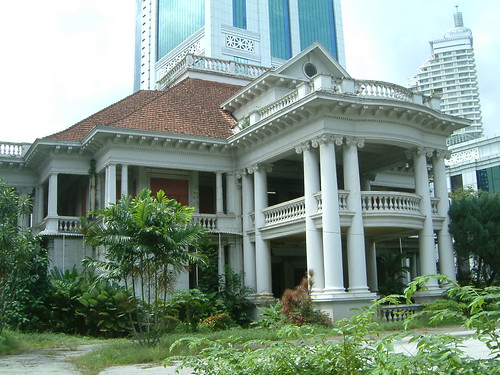
The Bok House, home to Le coq d'or restaurant, which Tan's
family patronised in his childhood. The building has been
demolished. As noted in the article: “As Kuala Lumpur has
modernized, parts of its history have been forsaken.”
According to the Wikipedia article on Bok House, the plot of
land where it once stood is now used as a temporary car park.
Chua Cheng Bok built the mansion in 1929. He started out poor, but became one of the richest men in the country and constructed his home in the Renaissance style, incorporating Chinese and Anglo-Indian elements into its design. In 1958 it was leased to a restaurant called Le Coq d’Or. In the early 1980s, when I was 10 or 11, my parents used to take my sister and me for dinner there once a month. Le Coq d’Or’s menu was Western: fish and chips, chicken chop, steak, but Malaysianized (the chicken chop came soaked in a mushroom gravy; the vegetables were steamed but still crunchy). The staff was Hainanese, of the kind much sought after as cooks by the English during colonial times.

On every visit I would wander around the poorly lit mansion. The lobby was tiled in squares of black and white. Italian marble statues covered in a skin of dust posed on heavy traditional Chinese blackwood furniture. A grand staircase with art nouveau cast-iron railings rose from the center of the lobby into the darkness of the closed-off second floor. The dining room smelled of starched tablecloths and stale frying butter. Oil paintings, murky with age, hung on the walls. Part of the thrill of exploring the house was my suspicion that it was haunted. Going to the washroom on one of my first visits, I turned down the wrong corridor and came to a room furnished with only an immense Chinese blackwood opium divan. The mother-of-pearl decorations on its headboard were elaborate and eerie, giving the divan a malevolent air.”

Sunday, 17 February 2013

Poet Recites Ode to Sihanouk, as Cambodia Weeps


“Thousands poured onto the streets of the Cambodian capital Phnom Penh for the royal funeral procession carrying the casket of former King Norodom Sihanouk. He will be cremated Monday in a Buddhist ceremony. Cambodians old and young mourned the revered Norodom Sihanouk, who passed in Beijing in October at the age of 89. His casket moved through six kilometers of central Phnom Penh streets, departing the Royal Palace and arriving at the nearby cremation ground. They wept. They chanted. They prayed. Among them was a 59-year-old farmer from Kampong Cham province named Tia Tha. In tribute to the late King, Tia Tha chants a poem he wrote when he learned of Sihanouk's death. VOA Khmer's Say Mony reports from Phnom Penh.”

Bones Will Crow: 15 Contemporary Burmese Poets – review | Guardian

Long faced by the permafrost of dictatorship, Burma’s poets have deployed metaphor to ingenious effect


The modernist phase of Burmese poetry, known as khitsan (meaning “testing the times”), emerged in the 1930s from Rangoon University and was associated with opposition to British colonial rule. Since then, poetry in Burma has retained a political significance unthinkable in the west. The odd dim schoolteacher aside, who would seek to censor poets in Britain, for example? When the military seized power in 1962, Burma became in many respects a closed country, culturally as well as politically – “a Stone Age cave sealed by stones”, in the words of Maung yu Pi in ‘The Great Ice Sheet’, leaving “a great culture, dilapidated and yellowing”. Poetry, with a long and distinguished history in Burma, is a form to which the country’s readers naturally turn. Under the permafrost of dictatorship, poets needed ways to write without finding half the words inked out. They proved as ingenious in metaphor as the times required.

This is not a new story: eastern Europe was the same before 1989 (and eastern European poets were among those read by Burmese writers). We must wait to see if the same price – the collapse of the literary audience – is paid for liberty in Burma, although the deeply embedded traditions of Buddhism, which appear frequently in the poems, might arrest that process. Zeyar Lynn‘s introduction to <i>Bones Will Crow</i>, the first anthology of contemporary Burmese poetry, sketches various contemporary positions that have grown out of the movement away from the traditional poetic form of the internally rhymed, four-syllable line. There is a broad church approach, as well as 1970s innovation (khitpor) and the contemporary postmodern (does this sound familiar?). It sets the scene for future disappointment without directly invoking the possibility.”

A new anthology of Thai short fiction brings out the best of 2012 in English translation

“Translation is a time-consuming, arduous and often thankless task. Literary translation also involves suppressing some natural impulses to interpret, edit and impose a personal style, while remaining in the background and allowing the tale to take root in another language.


Marcel Barang, 67, is not just a translator but active in the literary sphere, promoting the talents he feels merit it. In 12 Thai Short Stories _ 2012 he collated a dozen of last year's finest short fiction by Thai writers into an accessible and absorbing e-book. The styles and subjects are a study in contrasts, pointing to increasing depth and nuance in new Thai fiction. They are the ones, out of the hundreds Barang reads each year, that he feels stand on their own on merit.

This collection features a past SEA Write winner (Ussiri Dharmachoti) and nominee (Watn Yuangkaew), a prominent film critic (Wiwat Lertwiwatwongsa) and the 'Pink Man' poet and artist (Sompong Thawee) _ authors from the up-and-coming to the established.

Here the supernatural features prominently, with a three-eyed child, a village drowning in dog excrement, a ghost of a bygone revolution, a false pregnancy. There are also more prosaic slice-of-life pieces, with an excellent story on family funeral politics by Kajohnrit Ragsa, and on psychological disorders such as social phobia and madness. Murder also makes an appearance. In some stories, a poetic style takes precedence over narrative.

The anthology works well as a whole, but is inconclusive in terms of trends or what direction Thai fiction might be headed in 2013. In an interview, Barang told Brunch that the breadth of subject matter Thai writers work with continues to widen.”

Thursday, 14 February 2013

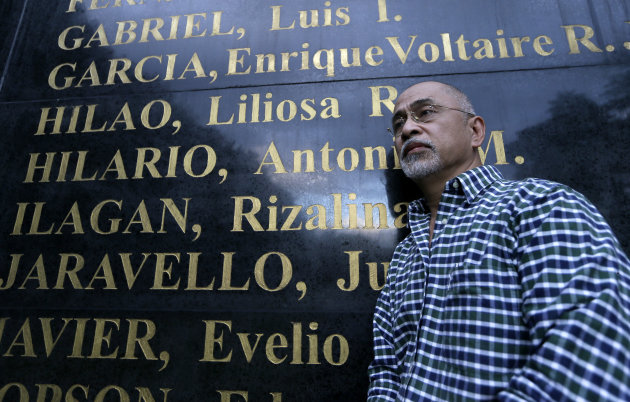
Playwright Bonifacio Ilagan and other Philippine dictatorship victims to be compensated


“Almost four decades after he was arrested and tortured and his sister disappeared into a maze of Philippine police cells and military houses, playwright Bonifacio Ilagan is finally seeing his suffering officially recognized.

A writer for an underground communist newspaper, Ilagan and thousands like him were rounded up by dictator Ferdinand Marcos' security forces after he placed the Philippines under martial law in 1972. Detentions, beatings, harassment and killings of the regime's opponents continued until Marcos was toppled in 1986.

Even though democracy was restored, it would take another 27 years for the Philippine Congress to vote on a bill awarding compensation and recognition to martial law victims. The bill was ratified Monday and will be sent to Pres. Benigno Aquino III for signing into law, said Sen. Francis Escudero, a key proponent.

"More than the monetary compensation, the bill represents the only formal, written document that martial law violated the human rights of Filipinos and that there were courageous people who fought the dictatorship," said a statement from SELDA, an organization of former political prisoners that campaigned for the passage of the bill.

Ilagan's story is more of a rule than exception among leftist activists of his generation.”

Saturday, 9 February 2013

Leeds Book Club: Interview with Tan Twan Eng

Both your books deal with the relationships between students and teachers. Have you had an inspirational teacher and what was the greatest lesson they taught you?

My teachers are all the writers I’ve ever read and still read: Vladimir Nabokov, Kazuo Ishiguro, Rushdie, Julian Barnes, Somerset Maugham, and many, many others. They taught me the different ways one can view and describe the world.

I felt when reading your books very ignorant about the part of the world you come from; do you feel that your books are helping to educate people around the world about the history of Malaysia? What sort of responses have you had from Western readers and how do they compare with readers in your country?

They seem to be helping to educate people around the world, although that isn’t my main purpose or intention when I write. Western readers have more questions about all aspects of my novels, from the setting and factual background to the characters. Readers in Malaysia are more interested in the characters than anything else, because they’re already familiar with the setting of my novels.